
La Princesa y el Sireno
Un lienzo arquitectónico, alquimia y muralismo.
The Princess & the Merman
An architectural canvas, alchemy, and muralism.
Rafael Uriegas
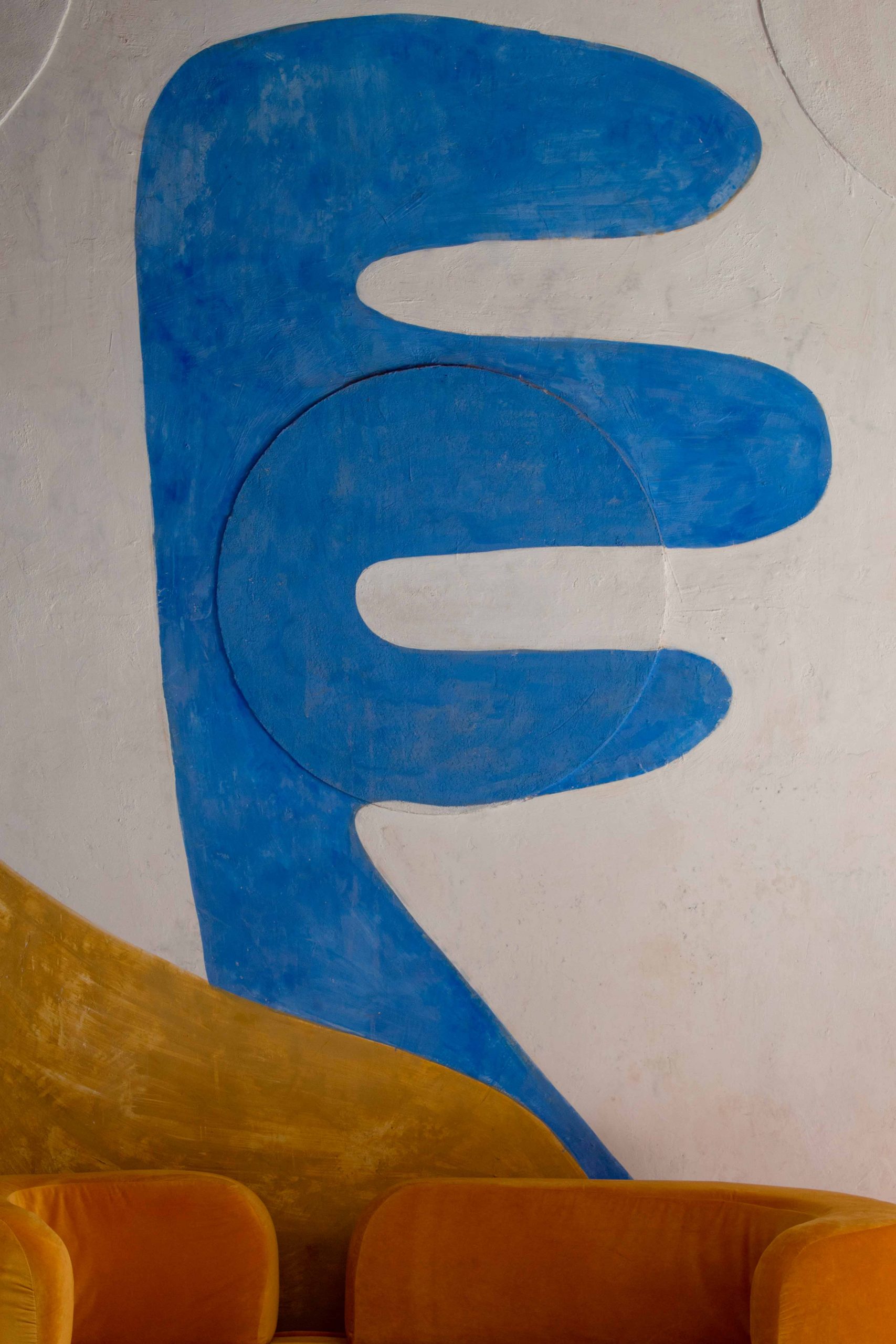
Un Fresco da vida a la cal, se mimetiza con el muro del que forma parte y con la arquitectura del espacio. La cal, concha molida, pasa por un ciclo: cal apagada-cal viva. Al secarse se vuelve piedra (cal apagada), al tener contacto con el agua sucede una reacción química, burbujea y se calienta (cal viva). El agua al penetrar la cal la vuelve pasta, es el cemento antiguo. Se aplana sobre la pared, estando fresco se aplican pigmentos sin minerales que filtran la cal, de ahí su nombre. Al secarse forma parte del mismo muro, se ha integrado al alma de este edificio.
Su narrativa es alegórica al ciclo de la cal, es circular; no tiene principio ni fin. Su existencia es la del espectador. Mitología ligada a la fertilidad y a la vida son parte del núcleo de la obra. Formas primigenias que hablan del mito de la creación. En cualquier parte del mural la narrativa se genera ante los ojos de quien la observe.
“El Muralismo es un hecho social, pintar un recorrido es diferente a pintar una escena en un cuadro. En este caso, el mural es todo, más cercano a un libro o una película. Se podría decir que la pintura mexicana es fundamentalmente mural. Desde Teotihuacán, mundo Maya, pasando por el barroco catequista que decora iglesias con fines pedagógicos, hasta finalmente entrar al muralismo post-revolución, que llega a ser la única vanguardia del continente.” – Rafael Uriegas
Fresco brings the lime whitewash to life; it camouflages itself within the wall that it’s part of as well as the architecture of the space. The lime, ground shells, moves through a cycle: from slaked lime to quicklime. When it dries, it turns to stone (slaked lime), and when it comes into contact with water, a chemical reaction occurs and it bubbles and heats up (quicklime). The water penetrates the lime and turns it into a paste; ancient cement. It is spread on the wall, and mineral-free pigments that filter the lime are applied while it’s still fresh, hence its name. When it dries, it becomes part of the wall itself, integrated into the soul of the building.
Its narrative is an allegory of the cycle of lime. It is circular; it has no beginning and no end. Its existence is that of the viewer. At the core of the piece is mythology linked to fertility and life, primordial forms that speak of the myth of creation. In any part of the mural, a narrative is created before the eyes of the observer.
“Muralism is a social fact. Painting a pathway is different from painting a scene in a picture. In this case, the mural is everything, closer to a book or a film. You could say that Mexican painting is fundamentally mural, from Teotihuacan in the Mayan world, passing through the catechist baroque that decorates churches for pedagogical purposes, until finally entering the post-revolution muralism, the continent’s only avant-garde. ” – Rafael Uriegas
RAFAEL URIEGAS
Nace en Noviembre de 1982, en Málaga, España. En 1991 se muda con su familia a la ciudad de México donde reside hasta el 2010 finalizando sus estudios en la Esmeralda, para después continuar sus estudios en la UAEM de Cuernavaca donde permanece hasta el 2013, mismo año en el que comienza su actividad profesional con una muestra en la galería Toca, un premio de pintura Tamayo y una beca del FONCA, Conacyt, entre otras. En 2015 se muda a la ciudad de Oaxaca.
Su obra forma parte de colecciones públicas en México y EU, como MOLA Long Beach, la Universidad de Texas, Maco Oaxaca, Musas Sonora, entre otras.
Su obra contiene muchas referencias religiosas, logrando una adaptación contemporánea muy particular de temas clásicos de la pintura, siendo a la vez una continuación y heredero de la tradición moderna latinoamericana, desde las abstracciones y vanguardias del continente, así como del barroco y arte prehispánico.
A través del dibujo practica estados meditativos donde su obra se silencia para llegar a una percepción puramente contemplativa. Su manejo del color genera atmósferas atemporales, donde convergen las historias de la pintura. Actualmente tiene un gran interés por desarrollar la pintura al fresco sobre muros, generando una expansión de formas dentro del espacio, para presentar ya una pintura envolvente.
Born in November, 1982, in Málaga, Spain. In 1991 he moved with his family to Mexico City, where he lived until finishing his studies at the National School of Painting, Sculpture, and Printmaking (La Esmeralda) in 2010. He later continued his studies at UAEM in Cuernavaca where he stayed until 2013, the same year that he began his professional career with a show at TOCA / Galería, an award from the Rufino Tamayo Painting Biennial, and a grant from the National Fund for Culture and Arts (FONCA), among others. In 2015, he moved to Oaxaca City.
His work is part of public collections in Mexico and the United States, such as MOLA Long Beach, The University of Texas, MACO Oaxaca, and the Sonora Museum of Art (MUSAS), among others.
His work contains many religious references, achieving a very particular contemporary adaptation of classical painting themes. It is at once a continuation and heir of the modern Latin American tradition, from the continent’s abstractions and avant-garde to baroque and pre-Hispanic art.
Through drawing he practices meditative states where his work becomes silent in order to reach a purely contemplative perception. His handling of color creates a timeless atmosphere in which the history of painting converges. He’s currently very interested in developing fresco painting on walls, expanding forms within the space to create a painting that envelopes the viewer.